

Mikov Butcher Knives


Mikov Butcher Knives for Meat Plants, Butcher Shops and Home Use
Czech manufacturer Mikov designs its butcher knives for meat processing plants, butcher shops and restaurants, as well as for processing meat at home. Each model has a blade shape made for a specific task: boning, trimming, portioning or chopping. This section offers 15+ items: individual knives in several lengths, a cleaver and a large set with a sharpening steel.
Two series: CLASSIC and LUX PROFI
The CLASSIC series is a range of working knives with tough plastic handles. The material doesn't mind moisture, fat or frequent washing, which is why these knives are the usual choice for meat plants where hygiene comes first. The handle stays secure even in a wet hand.
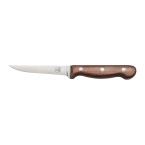
The LUX PROFI series uses the same professional blade shapes but adds rosewood handle scales. It is chosen by people who process meat at home or in a small workshop and value the look and feel of natural wood.
Blades in both series are made from quality stainless steel that cuts well and holds its edge under intensive use.
Types of butcher knives
- Straight boning knife (310) — 10, 12 and 15 cm. A narrow, stiff blade for separating meat from bone and trimming membranes and sinew.
- Curved boning knife (312) — 13 and 15 cm. The curve makes it easier to follow joints, ribs and rounded bones.
- Portioning / slicing knife (307) — 15, 18 and 20 cm in CLASSIC, 16 and 18 cm in LUX PROFI. A long, straight blade for cutting meat into portions and even pieces in one smooth stroke.
- Sticking / piercing knife (304) — 18 cm in CLASSIC and 15 cm in LUX PROFI. A sharp point for piercing and deep, precise cuts.
- Block knife (315) — 20 cm. A broad, heavy blade for working large cuts on a butcher's block or board.
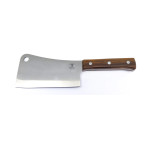
- CLASSIC 76-ND-18 cleaver with a wooden handle — for chopping through bone-in meat and cartilage.
Choosing knives for your tasks
For processing pork or poultry at home, two knives are usually enough: a 12–15 cm straight boning knife and an 18–20 cm portioning knife. If you often work with ribs, shoulder or ham, add a curved boning knife. For chopping bones you'll need a cleaver.
For a meat plant or butcher shop, buying a complete set makes more sense. The large Mikov set contains six butcher knives and a sharpening steel. More sets are in the Knife sets section.
Blade length depends on the task. A shorter blade gives more control next to the bone. A longer one lets you cut through a large piece in one stroke without leaving ridges on the cut surface. For everyday home cooking, Mikov kitchen knives are the more convenient choice.
Safety and hygiene
- When boning, cut away from yourself and keep your other hand out of the line of the cut. In meat plants, chain-mail safety gloves are used for this.
- Use separate knives for raw and cooked meat, and wash and dry them straight after work.
- Store knives on a magnetic holder or in sheaths, not loose in a drawer.
Honing and sharpening
During intensive meat work the edge rolls within minutes, so professionals hone their knives on a sharpening steel several times per shift. The steel doesn't remove metal; it straightens the edge. Full sharpening on a stone is only needed once honing no longer restores the edge.
Official supply
PROFI-INSTRUMENT is the official Mikov distributor in Ukraine, as confirmed by our dealer certificate. We supply genuine knives directly from the manufacturer. Some models are in stock; others we bring in to order. For meat plants and shops, we'll help you put together a set that matches your operations.
FAQ
Straight or curved boning knife?
The straight one is more versatile and handles most boning and trimming work. The curved one is better where you need to follow the bone: ribs, joints, shoulder.
How does a boning knife differ from a portioning knife?
A boning knife has a short, narrow blade for working close to the bone. A portioning knife has a long, straight blade for cutting meat into even pieces in one stroke.
CLASSIC or LUX PROFI for a meat plant?
Where hygiene rules are strict, plastic CLASSIC handles are the usual choice: they are easy to clean and don't mind moisture. LUX PROFI with rosewood scales is more often chosen for home use, farms or small workshops.


